What's New On Tom's Travel Blog?

Links to Linda's Photo Pages Have Been Added!
See The List On The Left


Almost all photos on this blog come from our Flickr Page. You can go directly to our Flickr photo sets by following this link. It's the easiest way to navigate our on-line photos.


Showing posts with label Computer History. Show all posts

Tuesday, October 14, 2025

Fur Trappers Rendezvous, 1825-40 -- Getting There, Part 1, Crossing North Dakota

Tom decided to visit several sites in Wyoming/Montana/Idaho associated with the famous fur trapper Rendezvous of the early 1800s.

Coincidentally, the American Computer Museum was presenting their annual Stibitz-Wilson Awards in Bozeman, MT, to several deserving computer scientists on Friday evening, Sept 26th. This seemed like an ideal time to take a week-long trip from the Twin Cities to these western states.

I always feel that a first day's drive west from the Twin Cities should get me to about Bismark (435 miles) and set out on Wednesday morning with that goal in mind.  Somewhere around St. Cloud, MNDOT signs were flashing warnings about "all lanes closed" and "use alternate routes."  Shortly before reaching Saulk Center, all traffic on I-94 slowed to a near stop and we proceeded at a walking pace for about three miles.

It seems a semi had overturned and was completely blocking the driving lanes and both shoulders of I-94.  (photo from radio station KNSI, here.)  

I skipped the stop at the Welcome Center in Fargo, although you can see it at this post from a previous trip in 2022. 

After checking in at the local Days Inn in Bismark, I visited the North Dakota state capitol building.  One of just a few capitols that do not feature a dome, this building presents a pretty view situated in a large grassy setting. 

NorthDakota-01

Several other views of the building can be seen on my Flickr Album for this portion of the trip.

The capitol was closed by the time I arrived but I had enough daylight to capture this statue of North Dakota's notable governor, John Burke, who managed to rise to the position of U.S. Treasurer in the Woodrow Wilson administration.

NorthDakota-06


And I had time to take several photos of the Sakakawea statue at the North Dakota Heritage Center adjacent to the capitol.

NorthDakota-13


NorthDakota-17


NorthDakota-19    NorthDakota-14


NorthDakota-21


NorthDakota-10


On the next trip I will have to make it a point to arrive in time to tour the Heritage Center. 

The Days Inn in Bismark turned out to be a good choice since they not only have the usual assortment of rolls and cereal available for breakfast, but from 7 until 9 in the morning, chef Cheyenne arrives to prepare eggs, sausage and hash-browns cooked to your specifications.  This proved to be the best "free breakfast" of the trip and Cheyenne received a generous tip!

On the second day, my modest goal was to reach Billings, Montana, just over 400 miles west of Bismark.  The speed limit on North Dakota and Montana Interstates is 80 MPH so it is not a long day's drive but there is a great deal to stop and see along the way.

The occasional "Scenic View" signs highlight a number of sights, beyond just the green grazing grasslands.


NorthDakota-26    NorthDakota-25


NorthDakota-23


But sometimes it is worth stopping just to take a look at the road ahead.

NorthDakota-24


Of course, "Salem Sue," the world's largest holstein cow,  perched high on a hill is always worth a stop.  (Previous blog post here.)

NorthDakota-27    NorthDakota-28


And the Enchanted highway offers a chance for a nice drive through the farmland offering different views depending on the season. 

NorthDakota-33    NorthDakota-34


NorthDakota-35


NorthDakota-37    NorthDakota-38


After a change of time zone from Central to Moutnain,

NorthDakota-29


the highlight of the day was the painted canyon overlook at Theodore Roosevelt Park.  Note that there are hiking opportunities here of various length - allow time during your visit.  Autumn is an appropriate time to consider a longer stop here and take advantage of the moderate temperature.

NorthDakota-62


This was a calm day (it can be quite windy at times crossing North Dakota.)  Visitors were lingering at the overlook and enjoying the view. 

NorthDakota-60


NorthDakota-43    NorthDakota-44


NorthDakota-41


NorthDakota-46


NorthDakota-59


NorthDakota-50


Tuesday, February 15, 2022

Catching Up On the Travel Blog - 2021 - New York And The Return Home To Minnesota

Crossing into New York State, we encountered  a welcome center that showed off the history of the Erie Canal.  This was a heavily traveled route for many immigrants headed to the west - to points like Michigan.  I suspect my Kolkowski ancestors took this route into Buffalo.

NewYorkErieCanal-17


NewYorkErieCanal-07      NewYorkErieCanal-12


Farther to the west, we spent the night at Auburn where William S. Burroughs spent a good bit of his younger days working at a bank where he learned the value that his adding machine technology could bring to that industry.  I took a few pictures of Burroughs ancestral sites nestled in this Finger Lakes area.

FingerLakes-07      FingerLakes-10


Beyond the Finger Lakes, we didn't make many unnecessary stops, so onward to the west we drove.  As always, Wisconsin offered several historic tidbits at their rest stops.

HomewardBound-13


 More photos are available here for:

   Erie Canal

   Finger Lakes Area

   Ohio to Minnesota


Thursday, February 10, 2022

Catching Up On The Travel Blog 2020 - Leadville, Colorado - National Mining Museum

We had been planning a trip to Peru to visit the high-altitude ruins at Machu Pichu when we returned from Egypt in 2020.  Of course, the Covid crisis prevented that, so a visit to the much higher town of Leadville, Colorado would have to substitute.


ToLeadville-19


We arrived late in the afternoon of Sept 24, 2020, but not too late to tour the National Mining Museum and Hall of Fame.

Leadville-06


Leadville was a boom-town more than once in the 19th century as gold was discovered and mined, then silver, and of course, lead.  With a population peaking at around 30,000 it was the second largest city in Colorado.

Leadville-07


There is an excellent view of downtown from the hill beside the museum.

Leadville-05


The well-preserved Dexter miner's cabin is nearby at the Healy Museum.  A less pretentious cabin can be found near the Carnegie Library a couple of blocks away along with a stamp mill from the mining era.

Leadville-02 Leadville-10


Leadville-11 Leadville-12

We toured the Mining museum and walked past a few other attractions before heading out of town to a couple of mining sites where little or nothing would remind of you of the boom days.


P1110165_edited-1 Leadville-13


There is quite a bit of interesting history here.  Wikipedia offers this note on the early days:

As the population boomed, by 1878 Leadville had the reputation as one of the most lawless towns in the West.  The first city marshal was run out of town a few days after he was appointed, and his replacement was shot dead within a month by one of his deputies.


There are still almost 3,000 residents in Leadville and we found an excellent dinner at the Treeline Kitchen downtown.

There are more pictures at the Flickr Album, of course.


Tuesday, January 4, 2022

Catching Up On The Travel Blog 2020 - Minnesota to Boise, Day 3 - Bozeman and the American Computer Museum

 Bozeman, Montana, was an interim destination on our way to Boise.  Linda had become acquainted with a distant cousin via her genealogical research and, of course, it was a chance for me to visit the American Computer Museum again.

While Linda and her cousin compared notes and family photos looking for more clues, I headed over to the museum.

BillingsComputerMuseum-01


The American Computer Museum is currently in reduced size quarters near the Montana State campus.  This means that their Burroughs 205 Datatron is stored in an inaccessible corner of their warehouse along with a couple of other mainframes, so I couldn't update the poor quality pictures that I took back in 2006.

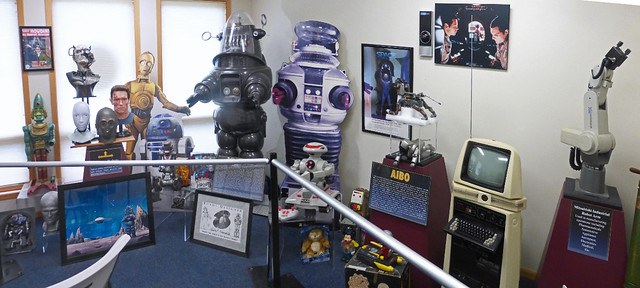
But, I was able to capture a few new pictures.  The ACM has expanded its name to become the American Computer & Robotics Museum.  They have added a robotics exhibit and include a large area dedicated to cryptography as well.

But, without the Burroughs 205, I focused my attention and camera on the Consolidated Engineering Company's analog CEC-103 which was designed by Cliff Berry of Atanasoff-Berry-Computer fame.   

BillingsComputerMuseum-03


PICT0015a   CEC103-3


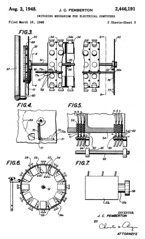
If you have ever wondered just what is inside that box, and how it operates, you need go no farther than United States Patent # 2,446,191 belonging to JC Pemberton.  JC (That is his name, not initials) oversaw the construction of the CEC 30-103 and was also a contributor to the ABC back at Iowa State, in his student days.

CEC103-2   1498395451294318374-02446191   1498395451294318374-02446191


The ACRM robotics room has an interesting collection of both practical and Hollywood robots.

Robots-2


Robots-1


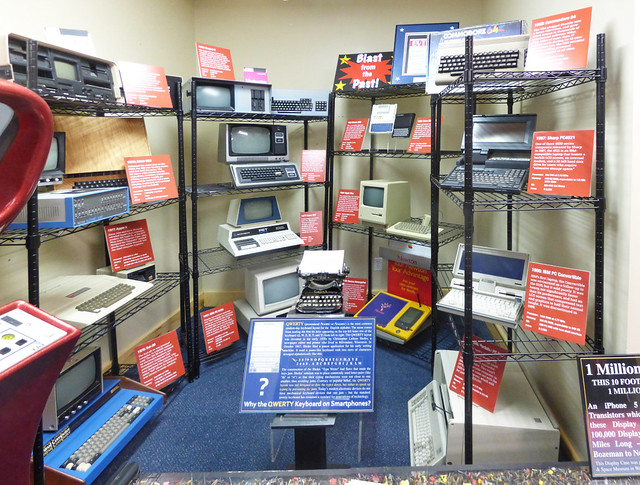
The microcomputer/personal computer exhibit has quite a variety of machines including the Altai, as well as its debut photo on Popular Electronics.  Note the autographs on the cover from the authors of Basic!

BillingsComputerMuseum-04


Altair-1   Altair-2


 A cryptography exhibit features some material from NCR's very secret code-breaking work in Dayton Ohio.  

BillingsComputerMuseum-07


And, yes there is even another NCR cash register on the premises.

BillingsComputerMuseum-08


This museum is a must-see stop for any computer person passing nearby.  Owner Barbara Keremedjiev and curator Elanor Barker are a delight to talk with.


Update - April, 2022:

I truly understated the significance of ACRM's Cryptography exhibit.  The museum has a German Enigma machine utilized by the Germans during World War II to encode tactical messages for their armed forces.  Breaking the code of the Enigma and of the higher level German "Ultra" teletype coded machines both led to computer development after the war in England and the U.S.  

So secret were these code-breaking activities that they remained largely hidden for thirty years, and perhaps some portions even into today.  Highly recommended reading are two books:  The Secret in Building 26 for the story of the American contribution at NCR in Dayton, Ohio.  Colossus: Bletchley Park's Greatest Secret for the British contribution.   


P1100855_edited-1   P1100854_edited-1


BillingsComputerMuseum-07   P1100837_edited-1

The ACRM does an excellent job of telling the story of these efforts and it is well worth an extra hour, regardless of what else may have attracted you to the museum initially.