What's New On Tom's Travel Blog?

Links to Linda's Photo Pages Have Been Added!
See The List On The Left


Almost all photos on this blog come from our Flickr Page. You can go directly to our Flickr photo sets by following this link. It's the easiest way to navigate our on-line photos.


Showing posts with label Montana. Show all posts

Tuesday, December 2, 2025

Fur Trappers Rendezvous, 1825-40 -- Getting There, Part 3, Pompey's Pillar

Pompey's Pillar National Monument lies about 35 miles east of Billings, Montana.  Although Linda and I have passed this location several times in the past, we always seem to have passed the monument outside of visiting hours.  I decided to make sure to stop and visit it on this trip.  This meant doubling back on Friday, the second day of my trip to the Fur Trappers Rendezvous sites.

As I pulled up to the entry gate, I could see the "pillar" brightly lit by the sun in the east.

PompeysPillar-02


This large sandstone rock formation contains the only physical reminders of the Lewis & Clark expedition of 1804-1806 commissioned by the third United States president, Thomas Jefferson, to explore and document the relatively unexplored land west of the Mississippi river.  

PompeysPillar-24


When Lewis & Clark returned from their trip to the mouth of the Columbia River after wintering at Fort Clatsop near present-day Astoria, Oregon, the two leaders split up at Travelers Rest near Missoula with Lewis proceeding along a northern route and the Missouri River and William Clark taking a more southern route and following the Yellowstone River.  The two rejoined at the junction of the two rivers.

At Pompeys Pillar, the visitor has the opportunity to get a nice glimpse of the route traveled by Clark and see his signature carved into the sandstone.  The stone formation is named for Jean Baptiste Charbonneau, (nick-named Pompey) the eighteen month old son of Sacagawea who had led Clark through the Bozeman Pass to the Yellowstone.

 Clark recorded his impressions of the site in his diary as follows:

“this rock I ascended and from it’s top had a most extensive view in every direction. This rock which I shall Call Pompy’s Tower [named for Jean Baptiste ‘Pomp’ Charbonneau] is 200 feet high and 400 paces in secumphrance and only axcessable on one Side which is from the N. E the other parts of it being a perpendicular Clift of lightish Co­loured gritty rock on the top there is a tolerable Soil of about 5 or 6 feet thick Covered with Short grass. The Indians have made 2 piles of Stone on the top of this Tower. The nativs have ingraved on the face of this rock the figures of animals &c. near which I marked my name and the day of the month & year.”

Barely visible in this closer view of the stone formation is the viewing stand that I would climb for the same view of the Yellowstone Valley that William Clark noted in his diary.

PompeysPillar-05


The Visitor Center is relatively new, completed in 2006 to celebrate the bicentennial of the Lewis & Clark expedition.  The center is operated on a seasonal basis and is closed from October through April.

PompeysPillar-17


The climb to the top of the pillar is accomplished via a wooden stairway.  About two-thirds of the way up, William Clark's autograph is enclosed in a wood and glass case.

PompeysPillar-23    PompeysPillar-29


PompeysPillar-31


The view from the top is well worth the climb with views both to the east and west.

PompeysPillar-36


For tourists unable or unwilling to climb the stairs, a nice view of the Yellowstone river is available at ground level.

PompeysPillar-27


Also, at ground level, is a replica of several of the autographs on the pillar, including Clark's.

PompeysPillar-26


A series of informative signs at ground level, titled as the "Yellowstone River Walkway" provides an informative description of this portion of Captain Clark's return journey.

PompeysPillar-09


PompeysPillar-21    PompeysPillar-22


PompeysPillar-20    PompeysPillar-16


PompeysPillar-11    PompeysPillar-10


One other sign depicts the deterioration and restoration of parts of the Pillar.  One strong earthquake and this monument will be gone.  See it while you can.

PompeysPillar-40


An exhibit outside the visitors center documents a bit of the life Montana's indigenous nations and their lifestyles.

PompeysPillar-12


PompeysPillar-15


Close by, an artist's conception of the river scene as it ay have appeared to a variety of travelers in 1873.

PompeysPillar-35


More photos at this Flickr Album.


Monday, November 17, 2025

Fur Trappers Rendezvous, 1825-40 -- Getting There, Part 2, Montana Border to Billings

Not far past Theodore Roosevelt National Park the traveler arrives at the Montana border.  At this point it is only about 80 miles north to the confluence of the Yellowstone and Missouri rivers.  At that river junction there are two tourist stops memorializing Fort Union, built by the Americans to establish territorial rights versus the Hudson Bay Company trappers in the area.  I chose not to take the trip up to inspect these on this trip but will keep it prominently in mind for the next visit to the area.


Just past the border is Wibaux, a picturesque Montana town, worth stopping to see.  There is a visitor's center where you can pick up current Montana and Wyoming maps and walk the streets a bit and absorb the Montana small-town atmosphere.

Montana1-12


The town was named for Pierre Wibaux, an early settler and cattle rancher.

Montana1-16


It's about 250 miles from Wibaux to Billings.  That's only three hours of driving at Montana speeds but can make for a full day or more if you stop to browse some of the attractions along the way.  I stopped for gas and coffee at Glendive and was disappointed to discover that their dinosaur museum was closed

Montana1-19


Interstate 94 parallels the Yellowstone River in eastern Montana from Glendive to Livingston, just before reaching Bozeman.  Starting in much earlier times, travelers passed through this area on foot, in canoes and on trains before the highway followed this path.  Many interesting small towns appeared.  Here is a 1968 railroad timetable showing the schedule for both the Northern Pacific's limited and local trains along this portion of the route. 


There are many places to stop.  I pulled off at Terry to see if the county museum and Evelyn Cameron Gallery were open, (previous visit blog post here) but unfortunately they were not.  I was lucky to meet the museum curator, however, as he was just leaving after opening for a scheduled visitor.  He mentioned that there is now an exhibit across the street of World War II bombing photography at the Legion Hall.  Something to keep in mind for the next visit.

A few miles prior to reaching Terry, I saw a nice view of nearby bluffs along the Yellowstone as I-94 crossed the river.  I took the next exit and backtracked along the frontage road to arrive at one of Montana's many fishing access points.

Montana1-20


Montana1-23 

Walking down to the river's edge, I ran into a lady who works for the highway department and whose job description includes scraping bat guano samples off of the overpasses.  (See college thesis here.)  She suggested a spot near Terry for pictures of the red clay hills.

 Montana1-28 

Next time I pass through the area I will have to bring a couple of fishing rods including my fly-rod and pick up a five-day fishing license.   


There are several historical markers along this stretch of Interstate and a particularly nice one to stop and visit is the Rosebud and Cattle Brand site about an hour's drive west of Terry.

Montana1-34 

Montana1-36 


The parking lot, rest stop and historical marker give little indication of the spectacular view of the Yellowstone that lies just beyond the picnic table enclosed by a windbreak. (see red arrow in photo below)  The visitor might be discouraged by the snake warning but walking out to the edge of the bluff gives a very rewarding view of the river valley and the grove of cottonwood trees on the far side of the Yellowstone.

Montana1a-1    Montana1-48 

Montana1-38

Montana1-43


Forsyth seemed like a town worth visiting briefly since it is marked with a large "F" and a cross on the hillside south of the highway.  The town lies on the north side of the freeway and boasts two fishing access points on the Yellowstone.

Montana1-44


I bypassed the town of Hysham this year.  Intrigued by the sign a bit east of town we did take a brief tour on our 2020 trip


I arrived at Pompey's Pillar which is about thirty miles east of Billings too late to visit this National Monument.  We have passed this monument several times in the past but always seem to arrive very late in the afternoon and have not stopped.  I decided that I had enough time to double back the next day and we will explore it in the next blog post.

More photos at this Flickr Album.  


Tuesday, January 4, 2022

Catching Up On The Travel Blog 2020 - Minnesota to Boise, Day 3 - Bozeman and the American Computer Museum

 Bozeman, Montana, was an interim destination on our way to Boise.  Linda had become acquainted with a distant cousin via her genealogical research and, of course, it was a chance for me to visit the American Computer Museum again.

While Linda and her cousin compared notes and family photos looking for more clues, I headed over to the museum.

BillingsComputerMuseum-01


The American Computer Museum is currently in reduced size quarters near the Montana State campus.  This means that their Burroughs 205 Datatron is stored in an inaccessible corner of their warehouse along with a couple of other mainframes, so I couldn't update the poor quality pictures that I took back in 2006.

But, I was able to capture a few new pictures.  The ACM has expanded its name to become the American Computer & Robotics Museum.  They have added a robotics exhibit and include a large area dedicated to cryptography as well.

But, without the Burroughs 205, I focused my attention and camera on the Consolidated Engineering Company's analog CEC-103 which was designed by Cliff Berry of Atanasoff-Berry-Computer fame.   

BillingsComputerMuseum-03


PICT0015a   CEC103-3


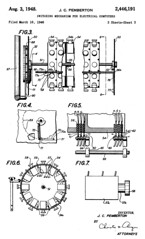
If you have ever wondered just what is inside that box, and how it operates, you need go no farther than United States Patent # 2,446,191 belonging to JC Pemberton.  JC (That is his name, not initials) oversaw the construction of the CEC 30-103 and was also a contributor to the ABC back at Iowa State, in his student days.

CEC103-2   1498395451294318374-02446191   1498395451294318374-02446191


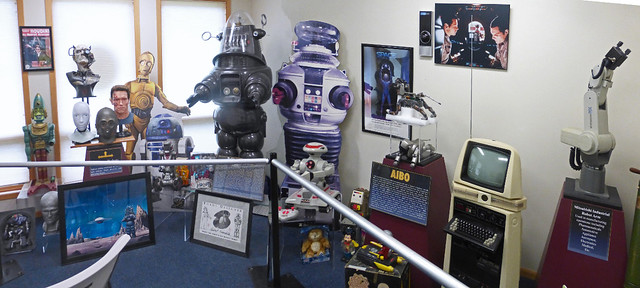
The ACRM robotics room has an interesting collection of both practical and Hollywood robots.

Robots-2


Robots-1


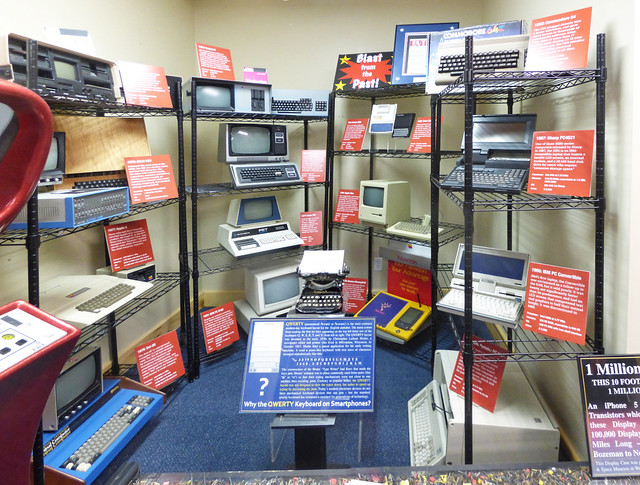
The microcomputer/personal computer exhibit has quite a variety of machines including the Altai, as well as its debut photo on Popular Electronics.  Note the autographs on the cover from the authors of Basic!

BillingsComputerMuseum-04


Altair-1   Altair-2


 A cryptography exhibit features some material from NCR's very secret code-breaking work in Dayton Ohio.  

BillingsComputerMuseum-07


And, yes there is even another NCR cash register on the premises.

BillingsComputerMuseum-08


This museum is a must-see stop for any computer person passing nearby.  Owner Barbara Keremedjiev and curator Elanor Barker are a delight to talk with.


Update - April, 2022:

I truly understated the significance of ACRM's Cryptography exhibit.  The museum has a German Enigma machine utilized by the Germans during World War II to encode tactical messages for their armed forces.  Breaking the code of the Enigma and of the higher level German "Ultra" teletype coded machines both led to computer development after the war in England and the U.S.  

So secret were these code-breaking activities that they remained largely hidden for thirty years, and perhaps some portions even into today.  Highly recommended reading are two books:  The Secret in Building 26 for the story of the American contribution at NCR in Dayton, Ohio.  Colossus: Bletchley Park's Greatest Secret for the British contribution.   


P1100855_edited-1   P1100854_edited-1


BillingsComputerMuseum-07   P1100837_edited-1

The ACRM does an excellent job of telling the story of these efforts and it is well worth an extra hour, regardless of what else may have attracted you to the museum initially.