What's New On Tom's Travel Blog?

Links to Linda's Photo Pages Have Been Added!
See The List On The Left


Almost all photos on this blog come from our Flickr Page. You can go directly to our Flickr photo sets by following this link. It's the easiest way to navigate our on-line photos.


Showing posts with label California. Show all posts

Thursday, May 10, 2012

Flying Home From San Francisco

Sunday afternoon I left SFO, heading back home to Minneapolis.  It was a beautiful day for flying and I got very lucky.  I had a window seat, a clean window and a sky with just the right amount of clouds to make it interesting.

I've never understood why a passenger would pull down their window shade and watch some Grade "C" movie when there is such scenery passing by as this.  We left SFO on the right-hand of the two South to North runways and then turned toward Oakland.  You can see San Francisco in the left photo (At the very left edge there is tiny image of a companion flight that departed on the left runway.) and downtown Oakland in the right one.  Click to enlarge.
TripHome-1 TripHome-2

Crossing over those verdant hills east of Oakland we passed the runways of Travis Air Force Base.
TripHome-3 TripHome-4

Soon, Sacramento drifted into view.  It is interesting to see the muddy Sacramento River swallowing the blue American River at this time of year.
TripHome-5

Just across Lake Tahoe, the shallow Washoe Lake beckons.
TripHome-6

With that, the clouds began to pile up a little thicker.  About a half hour after Tahoe, this valley appeared through an opening.  It is probably close to the Nevada/Utah border but some reader will have to identify it.
TripHome-7


Thursday, May 3, 2012

California State Capitol - Sacramento

After visiting with ERMA in Concord, I was less than seventy miles from Sacramento and I still had close to an hour and a half before sunset.  Should I try for another State Capitol for my collection?  Yes.

As I pulled into Sacramento, the River Cats must have been scoring some runs as fireworks were shooting into the air above Raley Field.  I headed straight for the Capitol building.

The Capitol, fronting on 10th street is an imposing sight as the sun begins to set and the lights come on inside.
California-33

It is difficult to photograph because of the large number of trees in the capitol mall park.  I really like that head on picture but there is something to be said for one that includes an orange tree too.
California-32

That surrounding mall park is quite large and I got a good look at it a couple of days later when my homeward bound flight passed right over the city.
California-26 California-39

The Capitol park has more religious symbols nearby than I expected.  Here is the famous sculpture of the Sisters of Mercy arriving in California.
California-27 California-28

And, of course, Father Junipero Sera stands watch over the whole state.
California-31 California-30

With my photo mission  complete, I called home for help choosing an interesting place to eat.  Linda Yelped me over to this excellent Thai restaurant on 12th.  I was glad it was now late because the place was filled and tables were just beginning to open up.
California-34


I left Sacramento at about 10:00 p.m. and it was a long drive back to Palo Alto.  On Friday night, it appears that just about everyone in California is trying to get to someplace else.

Wednesday, May 2, 2012

Concord, California - My Date With ERMA

I managed to get through Paul Morton's papers at Berkeley in the early afternoon.  That left me with just enough time to get over to Concord before Bank of America would close.

I was on my way to the Bank of America data processing center which houses one of the original ERMA check-processing computers.  This is a little known but very significant computer history exhibit.  Beginning in about 1950, Stanford Research Institute (SRI) took on a job for Bank of America to build a computer to handle check-processing.  SRI built a prototype for the bank.  Eventually, the Bank put out for bid the job of building production versions.  Remarkably, the job went to General Electric, who not only was not in the computer business but whose CEO, Ralph Cordiner, wanted to make sure didn't get into the computer business.  This obviously makes for an interesting story and you can read about it in this book, King of the Seven Dwarfs by Homer Oldfield.  As I write this post, there are six used copies of the book available used on Amazon at prices ranging from $124 to $753.  It is a good read!

Unfortunately, traffic was heavy heading to Concord, I missed the exit, and silly me, I kept looking for a building with a big Bank of America sign on it.

By the time that I pulled into the parking lot, it was about 5:30.  But I had longed for a look at ERMA for many years.  Maybe she would be visible through a window?  I was in luck.  The technology center runs multiple shifts and ERMA resides near the cafeteria in Building 2000.
California-25

ERMA shares the entry to the cafeteria with B of A bank founder, A. P. Giannini, a fitting tribute to her importance.  This picture shows the whole unit.
California-24

Most bankers are going to be interested in the check sorter and the discussion of magnetic ink characters at the bottom of all our checks.
California-23

You and I, of course, are more interested in the computer.
California-21

The man who spearheaded the effort on ERMA - and saw to it that those funny looking numbers on the bottom of all our checks got to be a standard was Al Zipf.  ERMA and I were standing in the Zipf building referenced in this NYT Al Zipf obituary.  (The sign pictured below was constructed when ERMA was exhibited in a different location.)
California-22

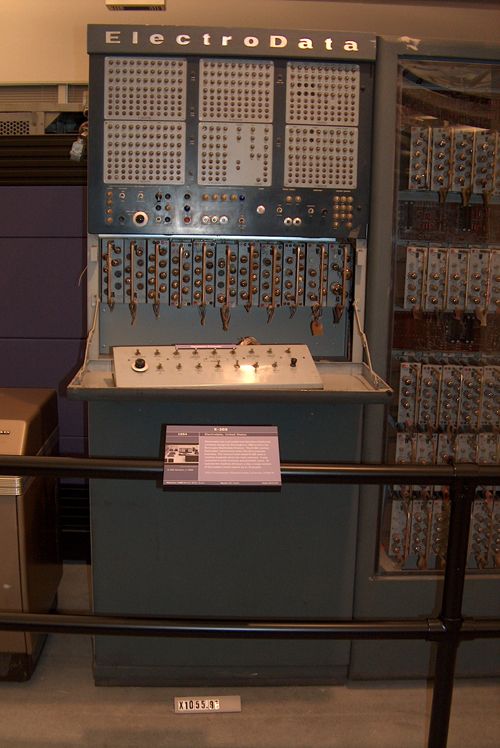
By the way, when SRI was building the prototype machine, they contracted with my favorite computer company, ElectroData, for memory drums and tape transports.  These were constructed in hush-hush fashion in rooms above the floor where the Datatron was being built in Pasadena.

I later discovered the reason I had trouble finding the B of A complex in Concord.  I guess I haven't been keeping up on the news.  This 2008 article notes BofA wanting to sell their four buildings in Concord for $200 a square foot.  This 2012 article says they were sold for $75 a square foot in 2011.  And this local blogger notes that the BofA sign was removed in March of this year.  If you want to see ERMA, you might want to hurry before she gets lost in the next move.


More on building ERMA can be found here.


Tuesday, May 1, 2012

University of California, Berkeley - 2012 and 1969

My next major stop after visiting the Computer Museum in Mountain View was Berkeley.  I was gathering some information about Electrical Engineering professor Paul Morton.  Morton managed to wrangle a grant from the Navy in 1948 and set about building the CALDIC (California Digital Computer.)

Morton had a remarkable group of E.E. students in the 1948-52 time frame including John Alrich and Jerry Foster who would be key players in the creation of ElectroData's Datatron down in Pasadena.  Other notable pupils were John Haanstra who would play a key role at IBM in the development of the 14xx line of computers, Al Hoagland who played a key role in the development of IBM disk technology and Doug Engelbart who invented the mouse that you are probably using to navigate this Web-page.  Morton must have been quite the teacher.


Berkeley has some very attractive areas on the campus.
California-17


The 307 foot tall Sather Clock Tower is a landmark, of course.  You can see the top of it on the right side of this picture.
California-18


As I was leaving campus, I couldn't help but notice that the campus police have a pretty tough-looking mobile command post.  
California-19

I didn't see any major threats to law and order.  This student group looked pretty peaceful.
California-20


I turned and took one last photo that captured the M. L. King Student Union.  It wasn't until I got home that I recalled I had several other shots in Sproul Plaza near the student union taken during my last visit to the campus in November of 1969.  Linda and I were honeymooning in the area and dropped in to see what was happening on this well-known campus.  I had just completed my army training and would soon to be en-route to Vietnam.
Berkeley12-1

Fashions have changed a bit since 1969.
Berkeley69-1

No one is collecting signatures on petitions to allow 18, 19 and 20 year-old to vote.  President Nixon brought that to pass
Berkeley69-2

There was a police presence on the Berkeley campus in 1969.  Not quite as imposing as the current mobile command post, though.
Berkeley69-3

But in looking at these pictures, I realized that while I was focused (literally) on random students, those campus cops appear to be hauling someone off to an undisclosed location.
Berkeley69-4 Berkeley69-5

Computer History Museum - Mountain View, California

This is part 2 of my visit to the Computer History Museum in Mountain View.  Part 1, featuring calculators and punched cards, can be found here.

The current exhibit at the museum is titled "Revolution" and covers a wide range of topics including early personal computers and even game systems.

I had a particular interest in the Atanasoff-Berry Computer (ABC).  This is the computer memorialized on the marker on the Iowa State campus.  I photographed the marker a few months back for this post and Cliff Berry's boyhood home for this post.

The reconstructed ABC had been on the Iowa State campus but now resides here at the Mountain View museum.  Two key components are the memory drum and the adder circuits.  Both were remarkable original contributions to the state of the art in 1940.
California-14 California-03

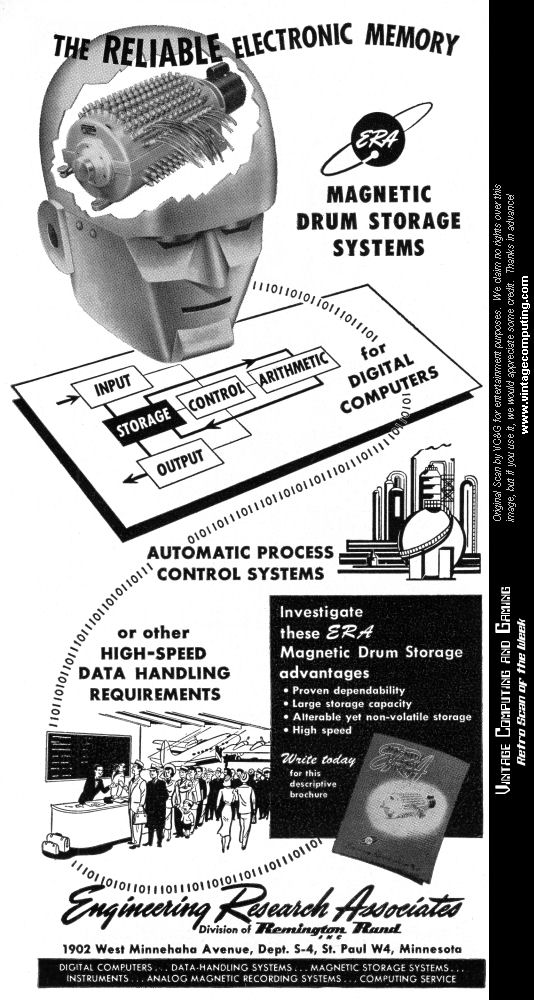
Another memory drum from the early 1950s was on display, this being one from St. Paul's ERA.  The museum displayed this with the drum and heads exposed, something I had never seen portrayed elsewhere. Notice the staggered heads.
California-15

And Williams tube memory!  Here are three samples including one from the SWAC (note that this one is on loan from Harry Huskey himself) and another that might be straight out of Freddie Williams lab in England.
California4-1 California4-2 California4-3

Speed and reliability killed those early memories off pretty quickly and magnetic core memory came to dominate the field in the 1960s.  These core memory exhibits come from Fabri-Tek.
California3-1 California3-2

Never heard of Fabri-Tek?  Well lets go to the Eau Claire (Wisconsin) Daily Telegram for March 24, 1962.  Fabri-Tek was preparing to open a new plant in Eau Claire in addition to expanding its main production facility in Amery, Wisconsin.  A couple of paragraphs from the article:
  ... The company has had a consistent record of growth each year and expects this to continue.  (Company president, Mike) Mickelson started Fabri-Tek just five years ago in the basement of his St. Paul home. His initial investment in equipment was $15.  Growth of the firm since then has been rapid.

 ... About 400 persons are employed in the three divisions with that figure to jump another 150 this year when the firm completes its move into the plant addition at Amery.

 ... MOST OF THE employees here, as they are in Amery will be housewives. The memory planes and stacks f o r computers are made up of thousands of tiny wires and are constructed by hand.
The museum has a Teletype Model 33 terminal along with one of those classy Anderson-Jacobson 300 baud modems in a wooden box.  (Note that the teletype was not running at that high of a speed - that was a 110 baud device!)  This was the "modern era" of timesharing from around 1968 when Pillsbury was in the timeshare service business with Pillsbury Call-A-Computer and crosstown rival, General Mills was manufacturing computers.  Ahhhh, those were the days.
California2-2 California2-3

And of course, the museum presents a System 360 console.  (Model 30)  This was the machine that changed it all and got almost everyone onto the same page.
California2-1

The 360 architecture dominated the industry from its announcement in April of 1964 through the next thirty years or more.  And that was in no small part because IBM developed machines that could string those memory cores as lower cost than the housewives in Amery.


Monday, April 30, 2012

Face Down, Nine-Edge First!

If that phrase, "face down, nine-edge first", brings back memories then plan to visit the Computer History Museum in Mountain View, California.
California-05

It's located immediately east of Highway 101 at exit 399 (Shoreline Blvd.)  This is just 25 miles south of the car rental returns at SFO.  Closed Monday and Tuesday.  Otherwise, get there well before it closes at 5:00 p.m. You will need at least a couple of hours for the self-guided tour if you had anything to do with computers in the 1950s, 60s or 70s.

The current exhibit is titled "Revolution."  It does a very thorough job of covering a wide period of computer history.  I'm going to break this tour up into two separate pieces.  This first one will cover just a few exhibits during the era of calculators through punch cards.  The second part will show you some of the computer exhibits.

I was disappointed to find that the ElectroData Datatron 205 which was exhibited previously has been returned to storage.  "It didn't make the cut," noted the archivist.  Apparently, I wasn't the first to ask, since she had been questioned about the lack of Burroughs equipment recently by another visitor.

So let's start our tour with the Burroughs adding machine that is part of the current exhibit.  They have a good specimen from 1912.  Unfortunately, the exhibit passes pretty lightly over what made Burroughs' adding machine special.  Look at the back of the machine.  It printed a tape with both the entries and the total.  Revolutionary stuff in the late 1880s.  Can't you just imagine the excitement in the eyes of a merchant or banker at seeing a printed audit trail coming out of the Burroughs "Adding and Listing" machine versus the numbers displayed on dials on the competitor's Comptometer?

Burroughs salesmen in the early 1900s were going from town to town selling their machines for $475 ($125 stayed with the salesman - that could buy 2 horses).  "Gather round boys," the salesman would say in the bar, "I have a machine that can add numbers and print the results faster than any man in this room!  And, it never makes a mistake."  A lot of bets were made on that claim.
California-02 California-07

Also in this area of the exhibit is a good example of a Marchant calculator.  Marchant was the Cadillac of calculators used by mathematicians, engineers and astronomers up through the end of World War II.  It was smooth-operating and fast.  See this chapter of Herb Grosch's autobiography, 2500 hours on a Marchant for more details.
California-01

Marchant calculators were made across the bay in Oakland.  But their chief designer was a fellow named Carl Friden.  Friden worked for Marchant beginning in 1918 but then started his own company a bit further south in San Leandro in 1934.  I found this picture of the Friden factory over in the San Leandro library.
California-38

Over in another corner of the exhibit there is a great collection of IBM punched card equipment.  Besides some very early machines there is a mint-quality group machines from the 1950-60 era.  I haven't seen a sorter like this one in years, much less the bins with cards hanging above it.
California-11

I photographed just the "business end" of the collator.  The model 026 keypunch should bring back lots of memories.
California-12 California-10

O yes, which way do you place those cards in the hopper on the sorter or the collator?  Well, face down, nine-edge first, of course.