In earlier times, a ride from the Cairo International Airport into downtown would have likely taken the arriving traveler along Salah Salem Street through the suburb of Heliopolis (in pink, below), past the Cairo Stadium, the Egyptian Air Force Museum and, of course, the most famous landmark, the Citadel and beautiful domed mosque of Mohamed Ali, situated high above the city.

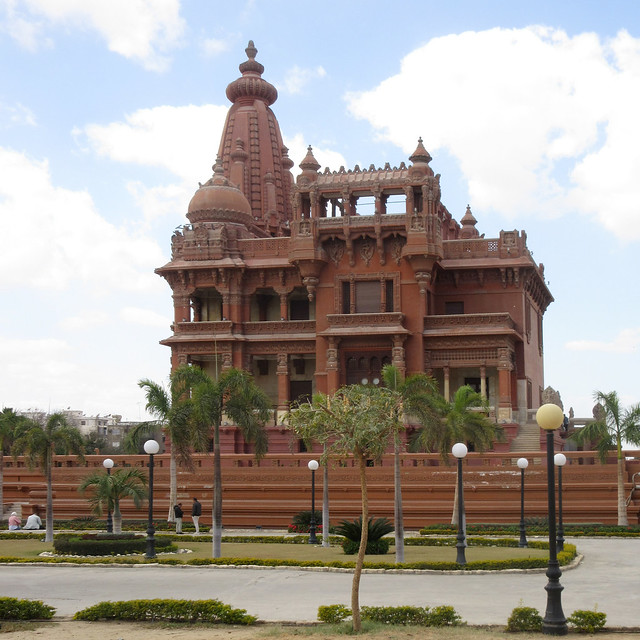
About a third of the way from the airport to downtown, Salah Salem Street passes by a large and stately red mansion. It might not be as easily noticed during the day, but is bathed in bright lights after dark.

This was the home constructed by the Belgian engineer and businessman, Edouard Louis Joseph Empain (1852-1929) as a part of his vision in the early 1900's to construct a new city in the vacant desert, ten miles northeast of Cairo, at the site of the once prominent ancient temple of Heliopolis. No stranger to large construction projects and transportation, Empain had built railways and subway systems in Brussels and Paris and was hard at work on another in the Congo.
Empain's new city, Heliopolis, would be connected to downtown Cairo by a streetcar line and have every imaginable amenity of the times. The resulting town attracted world wide attention and many of the palatial buildings and green-space areas remain today in this delightful and now densely-populated suburb.
At the time the Baron's palatial home was built, it truly was out in the middle of the desert.

An article in the Paxton, Illinois, Daily Record in April of 1909 described the growing town this way, for example:
CITY IN THE DESERT
SUBURB OF CAIRO, EGYPT, RISES FROM BURNING SANDS.
Boulevards, Flats, Electric Lights and Blooming Gardens. Make a Modern Oasis in What Was a Barren Waste. - —
Cairo.—Seven miles northeast of Cairo exists what is now called the Heliopolis oasis. When, three years ago, Cairo became so congested and there was a dearth of houses and building land, a group of financiers conceived the idea of transforming that part of the desert, arid and relentlessly barren though it was, into a spot fit for the habitation of man. With Bojhos Pasha Nubar, the talented son of the famous Nbar Pasha, and Baron Empain, the great financier, at their head, they obtained a concession of 1,000 acres from the Egyptian government, and later a company was promoted to carry out the project.
The majority of men out here scoffed at the idea; they said insuperable difficulties would be met with, and predicted the speedy erasure of the scheme, By dint of great pains the capital was subscribed. Unexpected difficulties were encountered in the water supply and the erection of the lighting plant, as also in the construction of the roads and railways.
Pluck and perseverance conquered all these obstacles, and on the spot where three short years ago there was nothing but dry sand and stones, there now stands a townlet—one might almost with truth call it a town—as a monument to the triumph of man's genius.
It is difficult to conceive the amount of work which the making of this new suburb of Cairo has entailed. The approach to the oasis from Cairo is along a magnificent macadamized road, which the company has laid down on the sand, and over which run electric cars to attract people to come out and see for themselves.
The oasis itself is intersected by similar roads all told out as boulevards, and in the center is a fine avenue planted with beds of turf, verdantly green. Houses and flats have been erected all over the place—many are already tenanted--and the gardens attached to each are fully planted, roses and other delicate flowers growing in great profusion.
In the main street is a line of attractive colonnaded shops, and although not yet finished, the majority are let. The company has erected a handsome casino and is now laying out a track for horse racing and all kinds of sport. There is also a large hotel, The Palace, nearing completion. It will contain 400 rooms, and will he opened soon. From what one can see of it at present it will be a magnificent edifice. The entire oasis is lighted by electric light which is supplied from the power station on the Nile bank ten miles away.
All the buildings are in the Moorish style with towers and minarets and are built of white marble and stone. As one gazes at it from afar one really thinks that this glittering white town in the midst of the desert, is but the delusive effect of the mirage, so often seen in this country. But closer inspection soon proves that it is a very substantial "City of the Sun."
The original intention of the promoters was to entice residents to go out to live at the oasis, and very low rents and special facilities have been held out. The idea is gaining favor. But as the air is so dry and pure and the view of the country all around is most beautiful, and quite unparalleled in Egypt, it is hoped that visitors will also be attracted, and that the oasis will become a veritable health resort.
Already the natives call it "Masr Gedida" (New Cairo), and under that name this gigantic scheme, which has already achieved such great marvels out of sand and stone, and thoroughly deserves the success which awaits it, will go down to posterity.
While the Heliopolis suburb continued to thrive over the years, the Empain home was badly neglected for a period of about sixty years following the 1952 Egyptian Revolution. Eventually taken over by the government and declared a national monument, The Empain Palace was restored from 2017 to 2020 and opened to the public. We had never managed to fit a tour into our winter schedule here but Linda made sure that we included it this year. It was a wise decision.
With our good friend, Roshdy, serving as translator and cultural interpreter, we approached the ticket office at the large grounds surrounding the Empain palace museum. Since we are now in the holy month of Ramadan, visiting hours are somewhat restricted so staff can make it home in time for the Iftar meal.
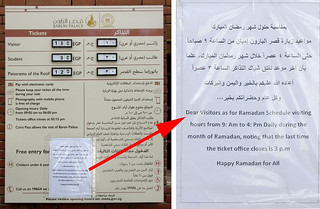
Tickets cost 180 Egyptian Pounds (about $3.50) with an optional admission to the rooftop observation deck costing another 120. The observation deck is well worth the extra charge.
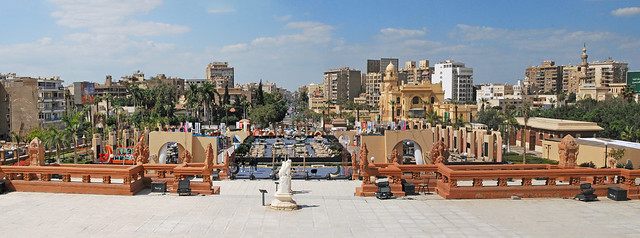
We began our tour by walking around the outside of the palace. The surroundings provide a bit of a sculpture garden and point out the magnificent view that the baron had at one time, extending all the way out to the Giza pyramids.

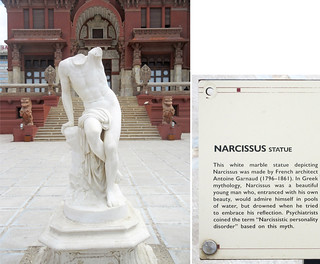
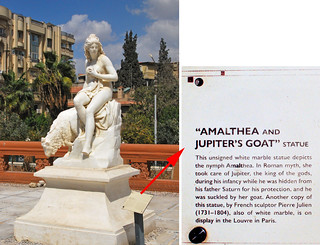
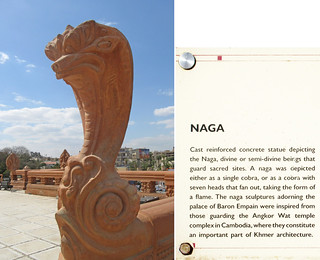

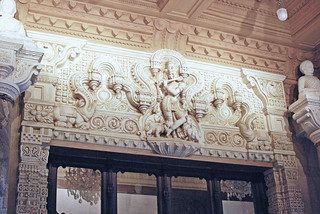
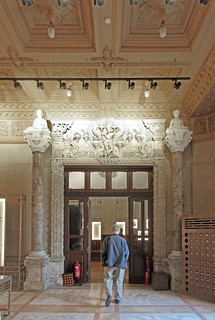
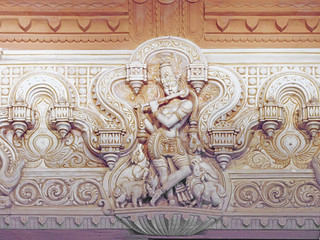
The entrance to the building definitely catches the eye. The mixture of European, Hindu, and Egyptian styles can be a bit overwhelming.

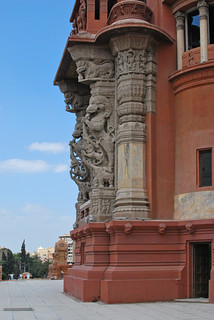
Pausing on the front portico, we took a long look across Salah Salem Street down the slope toward the Nile.
Starting out as a draftsman and engineer, Edouard Empain quickly took on the role of entrepreneur and construction magnate setting up at least sixty companies across multiple continents, focusing on transportation. Not limiting himself to the rails of streetcars and railroads, he was sponsoring an aviation meet in Heliopolis in 1910 and offered cash prizes for the first flight from Paris to Heliopolis in 1914.
No project of the size Empain contemplated is accomplished without strong political support and the baron intertwined business and politics in his partnership with Boghos Nubar Pasha. This was not a new role for Empain; he had political connections with King Leopold of Belgium and one source mentions that "... after much political intrigue, Édouard Empain won the contract to build the Paris metro, of which his group retained ownership until after the Second World War."

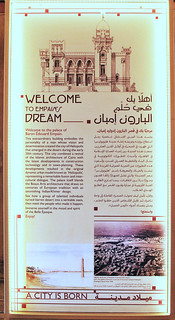
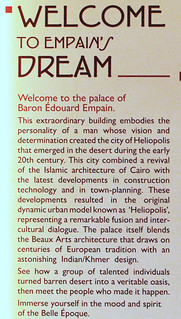
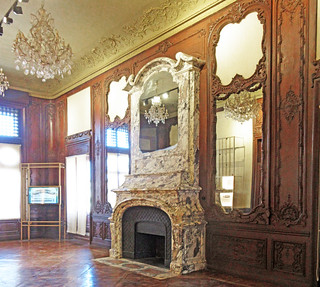
Restoration of the ground floor of the palace has revealed some extraordinary mixtures of style from France and Belgium to India and Thailand.
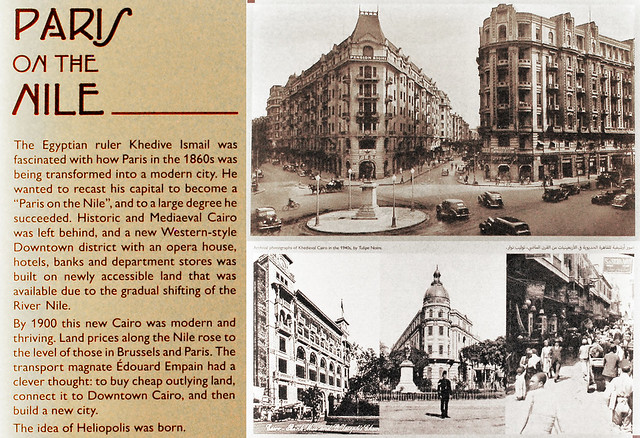
Egypt was an ideal location for the baron to fulfill his desire to build an entire city from the ground up because of the environment that had been established by the Egyptian ruler, Khedive Ismail, as he modernized the central city with his projects to build a "Paris on the Nile." Much of this survives in the current day downtown Cairo area from Tahrir Square to Talaat Harb Square.
Empain enlisted some of the best architects of his time to design his
personal home as well as key buildings in his new City of the Sun,
Heliopolis. The four shown below played key roles.
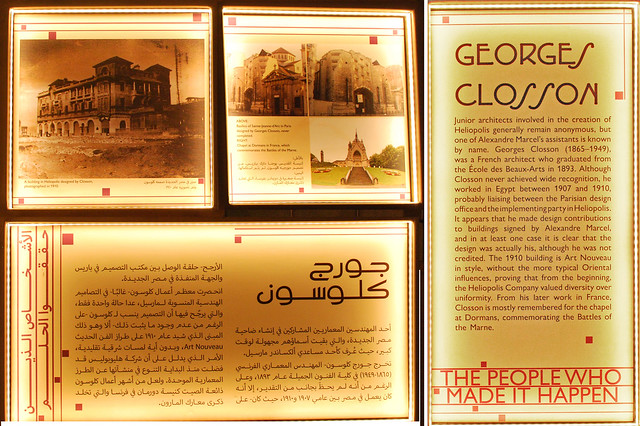


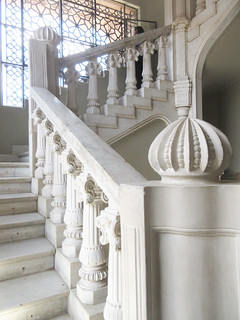
With that bit of introduction behind us, we ascended the marble staircase to the first floor.
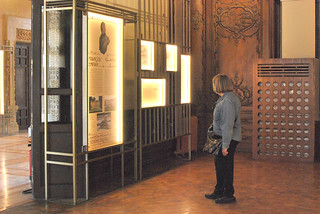
The first floor contains a number of exhibits that explain the restoration that was performed on the palace as well as an introduction to other key buildings of Heliopolis.
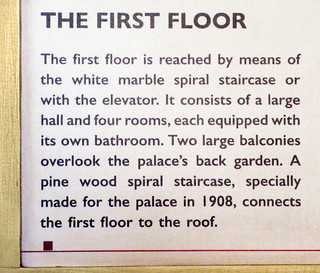
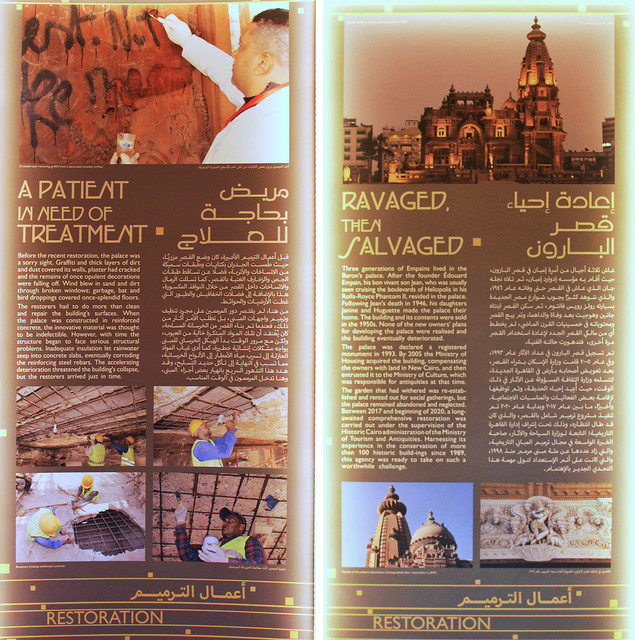
Several posters describe the work of rehabilitating the mansion:
RAVAGED, THEN SALVAGED
Three generations of Empains lived in the Baron's palace. After the founder Edouard Empain, his bon vivant son Jean, who was usually seen cruising the boulevards of Heliopolis in his Rolls-Royce Phantom II, resided in the palace. Following Jean's death in 1946, his daughters Janine and Huguette made the palace their home. The building and its contents were sold in the 1950s. None of the new owners' plans for developing the palace were realized and the building eventually deteriorated.
The palace was declared a registered monument in 1993. By 2005 the Ministry of Housing acquired the building, compensating the owners with land in New Cairo, and then entrusted it to the Ministry of Culture, which was responsible for antiquities at that time.
The garden that had withered was re-established and rented out for social gatherings, but the palace remained abandoned and neglected. Between 2017 and beginning of 2020, a long-awaited comprehensive restoration was carried out under the supervision of the Historic Cairo administration of the Ministry of Tourism and Antiquities. Harnessing its experience in the conservation of more than 100 historic buildings since 1989, this agency was ready to take on such a worthwhile challenge.
A PATIENT IN NEED OF TREATMENT
Before the recent restoration, the palace was a sorry sight. Graffiti and thick layers of dirt and dust covered its walls, plaster had cracked and the remains of once opulent decorations were falling off. Wind blew in sand and dirt through broken windows; garbage, bat and bird droppings covered once-splendid floors.
The restorers had to do more than clean and repair the building's surfaces. When the palace was constructed in reinforced concrete, the innovative material was thought to be indefectible. However, with time the structure began to face serious structural problems. Inadequate insulation let rainwater seep into concrete slabs, eventually corroding the reinforcing steel rebars. The accelerating deterioration threatened the building's collapse, but the restorers arrived just in time.
THE TREATMENT
The reinforced concrete ceiling slabs presented serious structural problems. In many cases, the reinforcing bars had to be exposed, cleaned of rust, given protective coating, and after additional reinforcements were added, covered again with concrete. Meanwhile, the mosaic pavement of the roof and the parquet floors from the interior were detached and taken to conservation labs for treatment. In many rooms, stucco ceiling decorations damaged by failing reinforced concrete slabs had to be temporarily removed, treated, and re-attached. The roof was properly sealed to keep out any water.
The team filled in and stitched cracks in the walls, completed and repainted the plaster, and inserted the missing parts of the stucco decoration. They carefully cleaned the desiccated and damaged "wood of the windows, doors, wall claddings and stairs of unsightly layers of later paint, dust and grime, repairing and protecting them as necessary.
The team also installed new electric wiring that followed the original design, with wires buried within walls and ceilings.
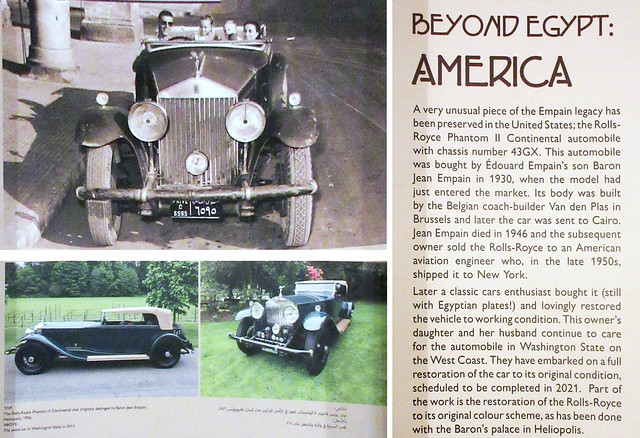
The first floor exhibits also introduce Edouard Empain's son, Baron Jean Empain. On one of the exhibits, Baron Jean is referred to as a "bon vivant." We also meet his Rolls Royce, apparently still in running condition in the U.S.A. in the state of Washington.
Tracing the descendants of the Baron is not an easy task. Edouard apparently had two sons, Jean (1902-1946) and Louis (1908-1976) When Edouard died in 1929, the 21 and 27 year-old sons found themselves at the head of a network of 80 companies across several continents.
Jean, referred to as a "bon vivant" above, is mentioned in a 1932 newspaper article in the Honolulu Advertiser upon his arrival in Hawaii aboard his yacht, the Heliopolis. In a 1937 full-page profile published in a Tacoma, Washington newspape, the 35 year-old Jean is featured as he married a 20 year old nude burlesque dancer, Rozelle Rowland. There is also mention of a 100 million dollar inheritance - quite a bit of money in those days! Rozelle outlived Jean by 60 years, passing in 2006. Jean is described in another place as doing a "tolerably good job (of managing the family business), despite an extremely dissipated life in which sumptuous parties and cruises on the yacht Heliopolis vied with evenings spent gambling in Europe’s most famous casinos."
Louis, on the other hand, lived a much more conservative and considerably lower profile life. Born to Edouard's mistress, Jeanne Becker, a musician, in 1908 he didn't inherit his father's name until 1921 when Edouard married Louis's mother. Oddly, Louis merits a Wikipedia entry, while Jean does not.
A third Baron Empain was Jean's son, Édouard-Jean Empain (1937 – 2018) who was kidnapped in 1978 in Paris. A finger-tip was severed by the kidnappers who sent it to the baron's family as proof of the kidnapping. That generated sufficient notoriety to interest newspapers world-wide.
Both baron Edouard Empain and his son, Jean, are buried in the nearby Our Lady of Heliopolis Cathedral.
The Boghassian Foundation appears to have the most complete story of the Barons Empain at this website.

For our friends in the architectural and construction community, many more pictures of architectural details are available at this Flickr Album, of course.









 Posts
Posts